 Image 1 of 1
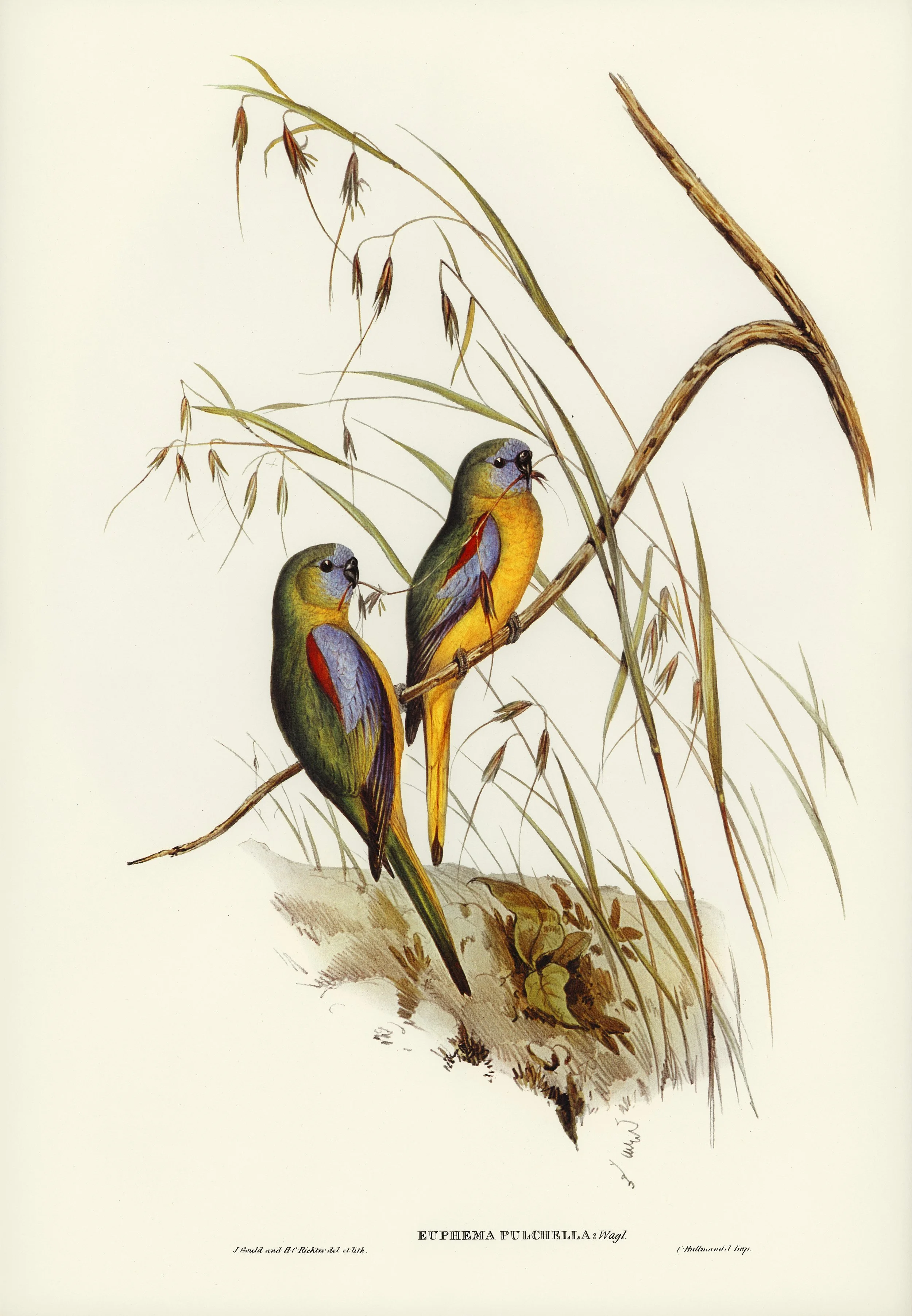
The companion piece to Sofia Petrov's Rifle Bird Study, "Euphema Pulchella — Turquoise Parrot Study" depicts the turquoise parrot (Euphema pulchella) of southeastern Australia — a small, exquisitely colored grassland parrot whose plumage combines warm olive-green upperparts, vivid turquoise-blue face and wings, and a luminous golden-yellow underside with a distinctive red wing patch. The lithograph depicts a pair of birds — their sexual dimorphism rendered faithfully, the male's colors more vivid, the female's slightly warmer and less saturated — perched on dry grass stems surrounded by the dried seed heads and curving blades of their native grassland habitat. The composition is vertical and spacious, the birds occupying only the lower two-thirds of the image with the long diagonal sweep of a dried grass culm extending upward and to the right above them — a compositional device that gives the work an airiness and openness perfectly suited to grassland subjects.
Isla's hand-coloring of this reproduction — applied over the printed lithographic lines in thin, precise washes of watercolor — brings a warmth and luminosity to the birds' plumage that the original print, however skilled, could not achieve. The turquoise of the male's face and wing panel is particularly extraordinary — a color that sits at the precise boundary between blue and green, shifting with the angle of the light from one to the other in a way that Isla has rendered through a careful layering of transparent blue and green washes that creates the same optical complexity in the flat medium of watercolor. The habitat detail — the dry grass stems with their seed heads, the sandy ground, the withered leaf at the lower right — is rendered with botanical precision and genuine feeling, the ordinary beauty of a grassland in late summer given the same careful attention as the extraordinary beauty of the birds it contains. This work, alongside the Rifle Bird Study, was acquired by the Natural History Museum in London for their permanent collection of natural history illustration.
The companion piece to Sofia Petrov's Rifle Bird Study, "Euphema Pulchella — Turquoise Parrot Study" depicts the turquoise parrot (Euphema pulchella) of southeastern Australia — a small, exquisitely colored grassland parrot whose plumage combines warm olive-green upperparts, vivid turquoise-blue face and wings, and a luminous golden-yellow underside with a distinctive red wing patch. The lithograph depicts a pair of birds — their sexual dimorphism rendered faithfully, the male's colors more vivid, the female's slightly warmer and less saturated — perched on dry grass stems surrounded by the dried seed heads and curving blades of their native grassland habitat. The composition is vertical and spacious, the birds occupying only the lower two-thirds of the image with the long diagonal sweep of a dried grass culm extending upward and to the right above them — a compositional device that gives the work an airiness and openness perfectly suited to grassland subjects.
Isla's hand-coloring of this reproduction — applied over the printed lithographic lines in thin, precise washes of watercolor — brings a warmth and luminosity to the birds' plumage that the original print, however skilled, could not achieve. The turquoise of the male's face and wing panel is particularly extraordinary — a color that sits at the precise boundary between blue and green, shifting with the angle of the light from one to the other in a way that Isla has rendered through a careful layering of transparent blue and green washes that creates the same optical complexity in the flat medium of watercolor. The habitat detail — the dry grass stems with their seed heads, the sandy ground, the withered leaf at the lower right — is rendered with botanical precision and genuine feeling, the ordinary beauty of a grassland in late summer given the same careful attention as the extraordinary beauty of the birds it contains. This work, alongside the Rifle Bird Study, was acquired by the Natural History Museum in London for their permanent collection of natural history illustration.