 Image 1 of 1
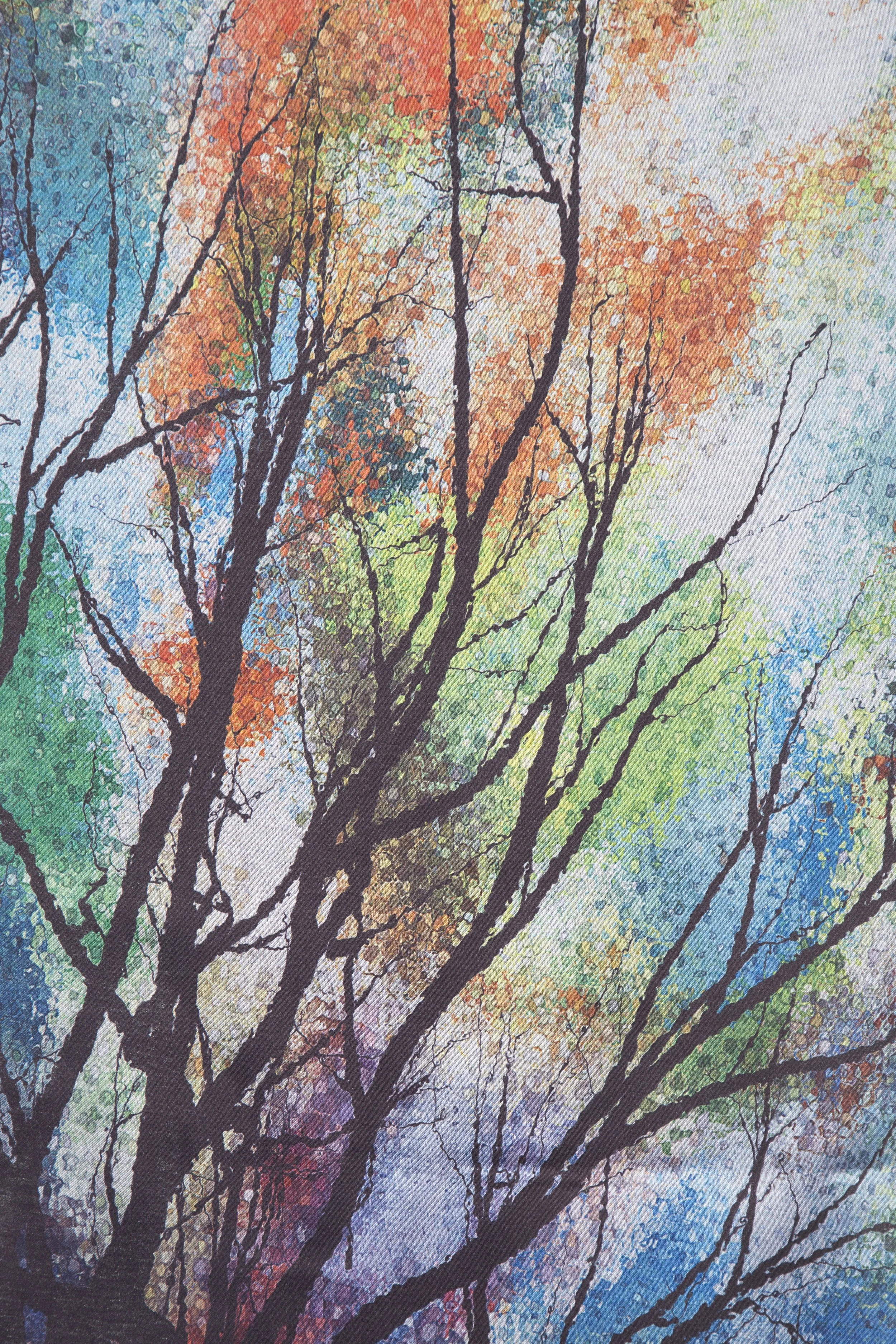
"Forest in Four Seasons" is one of the most technically complex and visually extraordinary works Kofi Asante has made in his ongoing exploration of the intersection between traditional African craft techniques and contemporary digital image-making. The work begins with a large-format photographic print of bare winter trees — their dark, branching forms silhouetted against a background of pure color — transferred onto canvas and then worked over extensively by hand. The background of the photographic image has been replaced through Kofi's digital process with a dense, pointillist field of color that covers the entire canvas in thousands of small, irregular dots of paint — the technique is reminiscent simultaneously of the Neo-Impressionist pointillism of Seurat and the intricate dot-pattern traditions of certain West African textile and body decoration practices that Kofi has studied extensively.
The color field behind the bare trees is extraordinary in its range and internal organization — moving from deep forest greens at the left edge through warm orange-reds and yellows at the center to cool blues, teals, and soft purples at the right, the whole composition mapping the full chromatic range of seasonal change across a single, unified image. The bare trees, their dark forms crossing and recrossing against this luminous background, read simultaneously as winter trees stripped of their leaves and as graphic elements — almost calligraphic in their precision and energy — that structure the composition. The contrast between the photographic specificity of the tree forms and the hand-made, artisanal quality of the background creates a productive tension between the mechanical and the human, the captured and the made, that runs throughout Kofi's practice. Thin lines of hand embroidery in gold and silver thread trace the finest branches and twigs at the image's outer edges, an addition that is almost invisible from a distance but that, discovered up close, completely transforms the work's relationship to the viewer's body and attention.
"Forest in Four Seasons" is one of the most technically complex and visually extraordinary works Kofi Asante has made in his ongoing exploration of the intersection between traditional African craft techniques and contemporary digital image-making. The work begins with a large-format photographic print of bare winter trees — their dark, branching forms silhouetted against a background of pure color — transferred onto canvas and then worked over extensively by hand. The background of the photographic image has been replaced through Kofi's digital process with a dense, pointillist field of color that covers the entire canvas in thousands of small, irregular dots of paint — the technique is reminiscent simultaneously of the Neo-Impressionist pointillism of Seurat and the intricate dot-pattern traditions of certain West African textile and body decoration practices that Kofi has studied extensively.
The color field behind the bare trees is extraordinary in its range and internal organization — moving from deep forest greens at the left edge through warm orange-reds and yellows at the center to cool blues, teals, and soft purples at the right, the whole composition mapping the full chromatic range of seasonal change across a single, unified image. The bare trees, their dark forms crossing and recrossing against this luminous background, read simultaneously as winter trees stripped of their leaves and as graphic elements — almost calligraphic in their precision and energy — that structure the composition. The contrast between the photographic specificity of the tree forms and the hand-made, artisanal quality of the background creates a productive tension between the mechanical and the human, the captured and the made, that runs throughout Kofi's practice. Thin lines of hand embroidery in gold and silver thread trace the finest branches and twigs at the image's outer edges, an addition that is almost invisible from a distance but that, discovered up close, completely transforms the work's relationship to the viewer's body and attention.