 Image 1 of 1
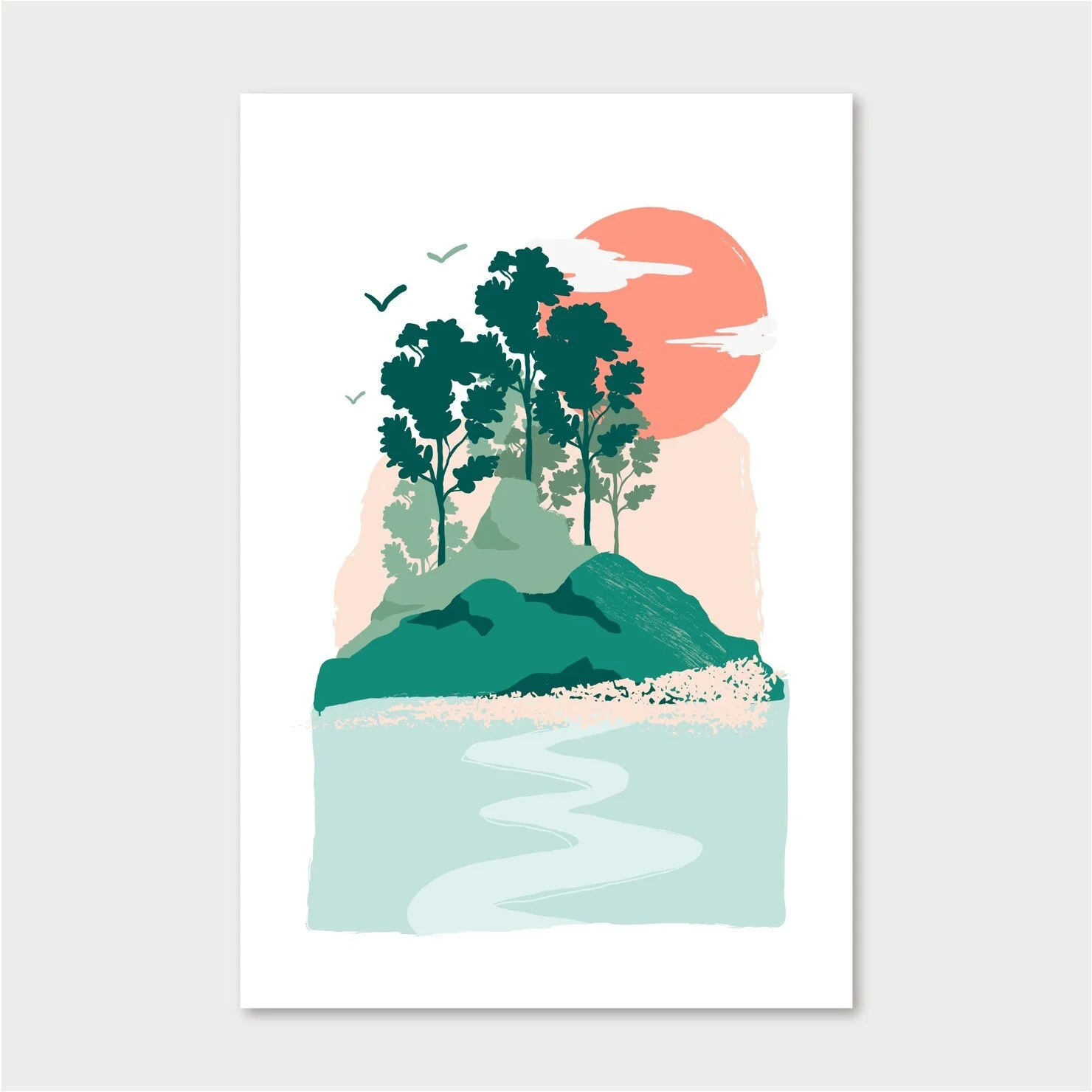
"Island at the Edge of Evening" represents a significant and surprising departure in Hiroshi Yamamoto's practice — a move into digital illustration that initially raised eyebrows among critics accustomed to his spare, material-focused sculptural installations, but that has since been recognized as a deeply consistent extension of his core artistic concerns into a new medium. The image depicts a small island rising from a calm, pale sea — a low hill covered in deep teal trees, their silhouettes rendered with the simplified, confident clarity of traditional Japanese woodblock printing, rising against a soft coral sun that fills the upper right of the composition with warm, diffuse light. Three birds in flight trace arcing paths across the sky. In the lower half of the image, the still water reflects the island and its trees in undulating white lines that suggest both stillness and the constant subtle movement of living water.
The image's palette is deliberately restricted and internally harmonious — deep teals and forest greens for the island's vegetation, soft coral and warm peach for the sun and its atmospheric glow, pale aquamarine for the water, warm sandy white for the beaches at the island's base. Every color relationship has been considered with the same precision and patience that Hiroshi brings to the arrangement of stones in his sculptural installations — nothing is arbitrary, nothing is merely decorative. The simplified, flat rendering of the trees draws consciously on the tradition of Japanese woodblock landscape printing while the compositional language — the centered, symmetrical island, the vast empty spaces of sea and sky around it — reflects Hiroshi's deep engagement with the Zen aesthetic of ma, the productive emptiness or interval between forms that gives each element its meaning and presence. The work has been widely reproduced and has introduced Hiroshi's practice to a new generation of collectors and admirers who encountered it through digital circulation before seeing the physical prints, of which only twenty exist in the world.
"Island at the Edge of Evening" represents a significant and surprising departure in Hiroshi Yamamoto's practice — a move into digital illustration that initially raised eyebrows among critics accustomed to his spare, material-focused sculptural installations, but that has since been recognized as a deeply consistent extension of his core artistic concerns into a new medium. The image depicts a small island rising from a calm, pale sea — a low hill covered in deep teal trees, their silhouettes rendered with the simplified, confident clarity of traditional Japanese woodblock printing, rising against a soft coral sun that fills the upper right of the composition with warm, diffuse light. Three birds in flight trace arcing paths across the sky. In the lower half of the image, the still water reflects the island and its trees in undulating white lines that suggest both stillness and the constant subtle movement of living water.
The image's palette is deliberately restricted and internally harmonious — deep teals and forest greens for the island's vegetation, soft coral and warm peach for the sun and its atmospheric glow, pale aquamarine for the water, warm sandy white for the beaches at the island's base. Every color relationship has been considered with the same precision and patience that Hiroshi brings to the arrangement of stones in his sculptural installations — nothing is arbitrary, nothing is merely decorative. The simplified, flat rendering of the trees draws consciously on the tradition of Japanese woodblock landscape printing while the compositional language — the centered, symmetrical island, the vast empty spaces of sea and sky around it — reflects Hiroshi's deep engagement with the Zen aesthetic of ma, the productive emptiness or interval between forms that gives each element its meaning and presence. The work has been widely reproduced and has introduced Hiroshi's practice to a new generation of collectors and admirers who encountered it through digital circulation before seeing the physical prints, of which only twenty exist in the world.