Midnight Bloom

€62.00

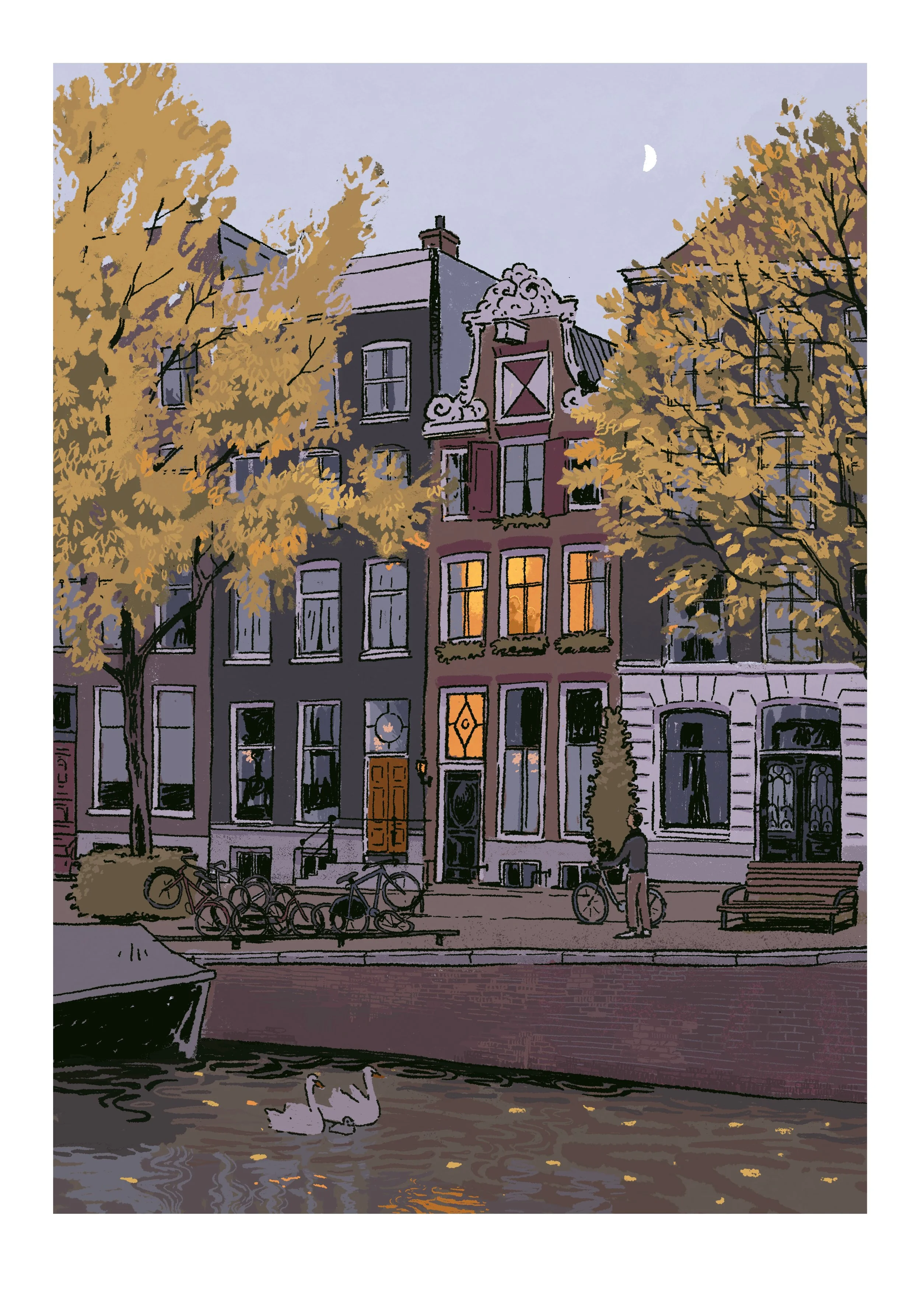
"Midnight Bloom" is the most ambitious and emotionally expansive work in Yuki Tanaka's printmaking practice — a woodblock print of extraordinary scale and technical complexity that pushes the traditional Japanese woodblock medium to the very edge of what it can hold without breaking. The print depicts a garden in the deep of night — specifically, the ancient moss garden of a Kyoto temple that Yuki has visited regularly since her student years and that she describes as the place she goes when she needs to remember what silence actually feels like. The garden is depicted at the precise moment when several night-blooming flowers — moonflowers, evening primrose, night jasmine — are at full, simultaneous bloom, their white and pale yellow petals almost luminous against the surrounding darkness in the way that only white flowers in darkness can be, generating their own light from within the night rather than merely reflecting what little light falls on them.

The print's technical achievement is staggering. Yuki carved seventeen separate printing blocks for this work — an unprecedented number even by her own demanding standards — each one depositing a subtly different layer of tone and texture that builds, over seventeen printing passes, a surface of extraordinary depth and complexity. The darkness of the garden is not a simple black but a living, layered darkness built from deep indigo, warm black, cool grey, and the ghost-impressions of underlayers that surface occasionally in the finished print as barely perceptible lighter areas, suggesting the presence of form and life within the dark. The flowers are achieved through a technique Yuki developed specifically for this work — printing in the palest possible grey ink over a ground prepared with a thin layer of mineral powder, creating blooms that seem to glow rather than merely appear pale, a luminosity that is the exact visual equivalent of seeing white flowers in darkness with the fully dark-adapted human eye.

The foliage surrounding the flowers is rendered with Yuki's characteristic combination of precise botanical observation and philosophical restraint — leaves suggested rather than fully described, their forms present enough to be read but incomplete enough to leave space for the viewer's imagination. Ancient moss-covered stones emerge from the lower portion of the composition in tones of deep grey-green, their surfaces textured through careful registration of multiple printing blocks to suggest the particular quality of moss at night — dense, soft, almost animal in its darkness and moisture. A single full moon sits quietly in the upper right corner, its presence felt more in the quality of light it casts on the garden below than in its own form, which Yuki has deliberately kept small and understated — a reminder that the garden's nocturnal beauty belongs entirely to itself. The complete edition of ten sold out before the prints were publicly shown, distributed to a waiting list of collectors who had followed Yuki's work for years and recognized immediately that this was something exceptional even by her exacting standards.

"Midnight Bloom" is the most ambitious and emotionally expansive work in Yuki Tanaka's printmaking practice — a woodblock print of extraordinary scale and technical complexity that pushes the traditional Japanese woodblock medium to the very edge of what it can hold without breaking. The print depicts a garden in the deep of night — specifically, the ancient moss garden of a Kyoto temple that Yuki has visited regularly since her student years and that she describes as the place she goes when she needs to remember what silence actually feels like. The garden is depicted at the precise moment when several night-blooming flowers — moonflowers, evening primrose, night jasmine — are at full, simultaneous bloom, their white and pale yellow petals almost luminous against the surrounding darkness in the way that only white flowers in darkness can be, generating their own light from within the night rather than merely reflecting what little light falls on them.

The print's technical achievement is staggering. Yuki carved seventeen separate printing blocks for this work — an unprecedented number even by her own demanding standards — each one depositing a subtly different layer of tone and texture that builds, over seventeen printing passes, a surface of extraordinary depth and complexity. The darkness of the garden is not a simple black but a living, layered darkness built from deep indigo, warm black, cool grey, and the ghost-impressions of underlayers that surface occasionally in the finished print as barely perceptible lighter areas, suggesting the presence of form and life within the dark. The flowers are achieved through a technique Yuki developed specifically for this work — printing in the palest possible grey ink over a ground prepared with a thin layer of mineral powder, creating blooms that seem to glow rather than merely appear pale, a luminosity that is the exact visual equivalent of seeing white flowers in darkness with the fully dark-adapted human eye.

The foliage surrounding the flowers is rendered with Yuki's characteristic combination of precise botanical observation and philosophical restraint — leaves suggested rather than fully described, their forms present enough to be read but incomplete enough to leave space for the viewer's imagination. Ancient moss-covered stones emerge from the lower portion of the composition in tones of deep grey-green, their surfaces textured through careful registration of multiple printing blocks to suggest the particular quality of moss at night — dense, soft, almost animal in its darkness and moisture. A single full moon sits quietly in the upper right corner, its presence felt more in the quality of light it casts on the garden below than in its own form, which Yuki has deliberately kept small and understated — a reminder that the garden's nocturnal beauty belongs entirely to itself. The complete edition of ten sold out before the prints were publicly shown, distributed to a waiting list of collectors who had followed Yuki's work for years and recognized immediately that this was something exceptional even by her exacting standards.