
THE ARTIST'S WORK
Summary Block
Bio -
Pauline Di Valentin, an artist from Amiens, produces ink drawings on paper depicting lost architecture in
the middle of abundant vegetation.
Pauline Di Valentin studied applied art from high school, and passed a BTS in visual communication at
the Lycée Auguste Renoir in Paris. She then joined the ESAD in Reims and obtained a DNAP in graphic
design. Today, she has found in ink painting the means to express the nuances of colours and textures
that inspire her.
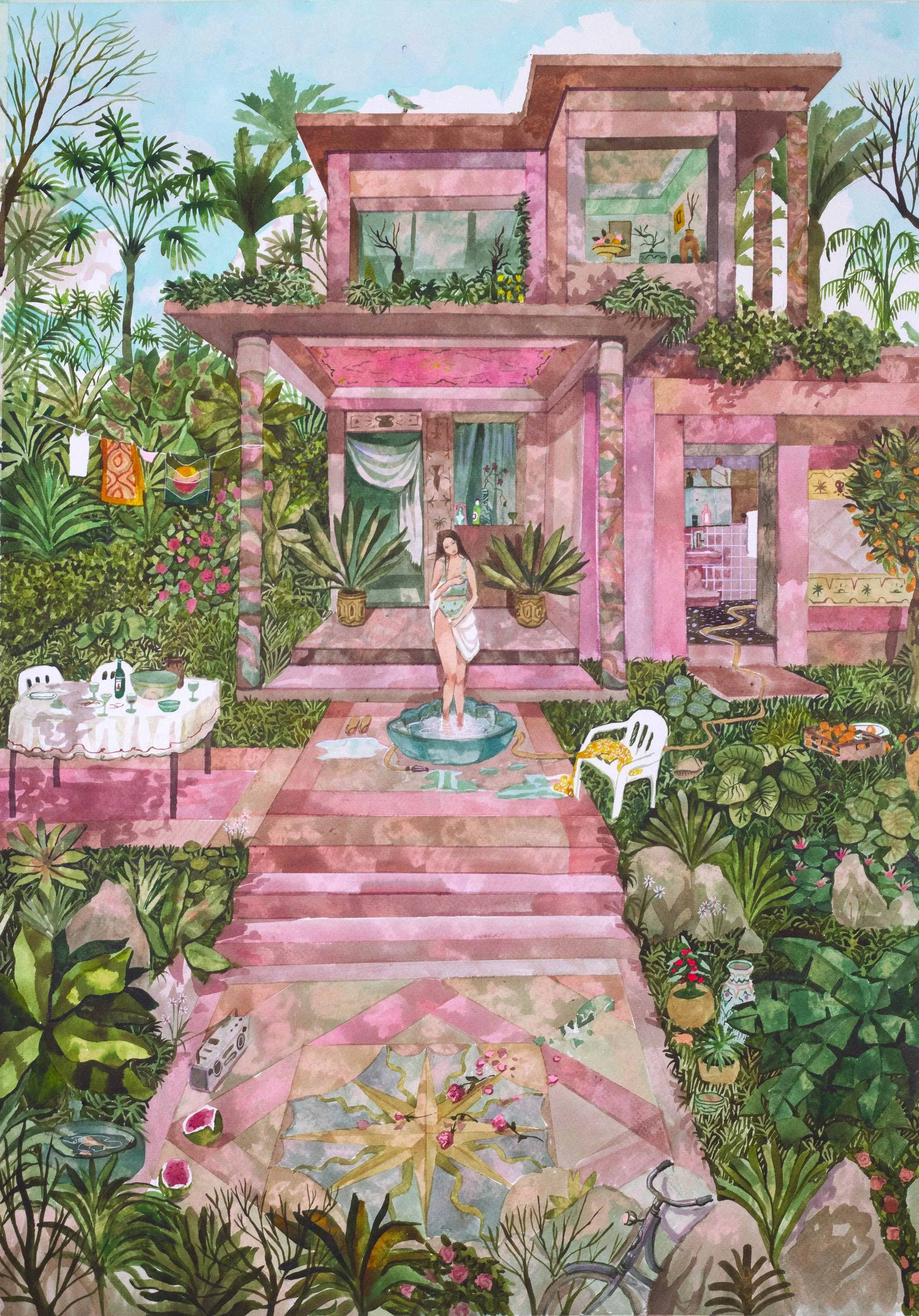
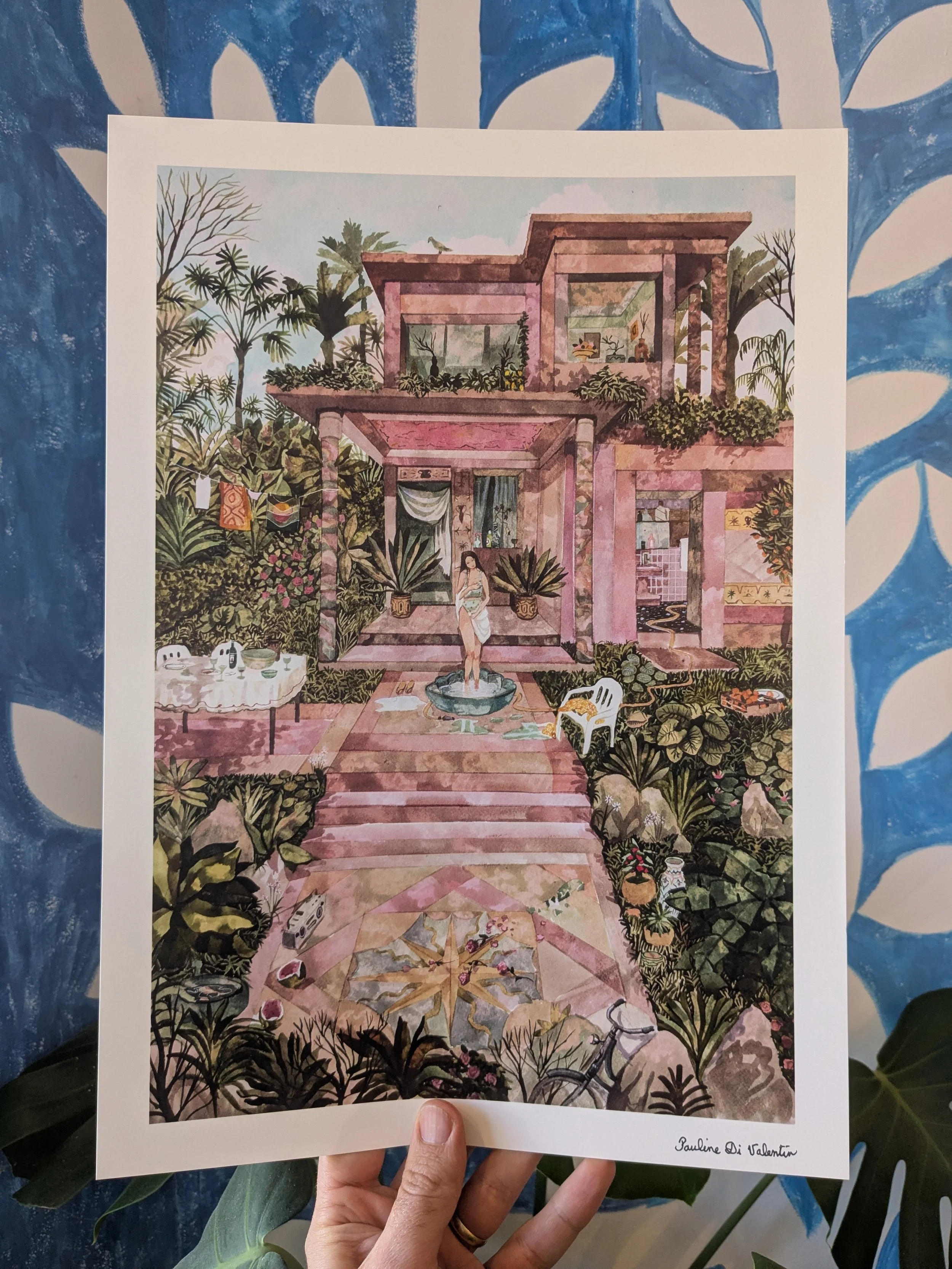
In these drawings on paper, pastel villas stand in an isolated neighbourhood, in the middle of a dense
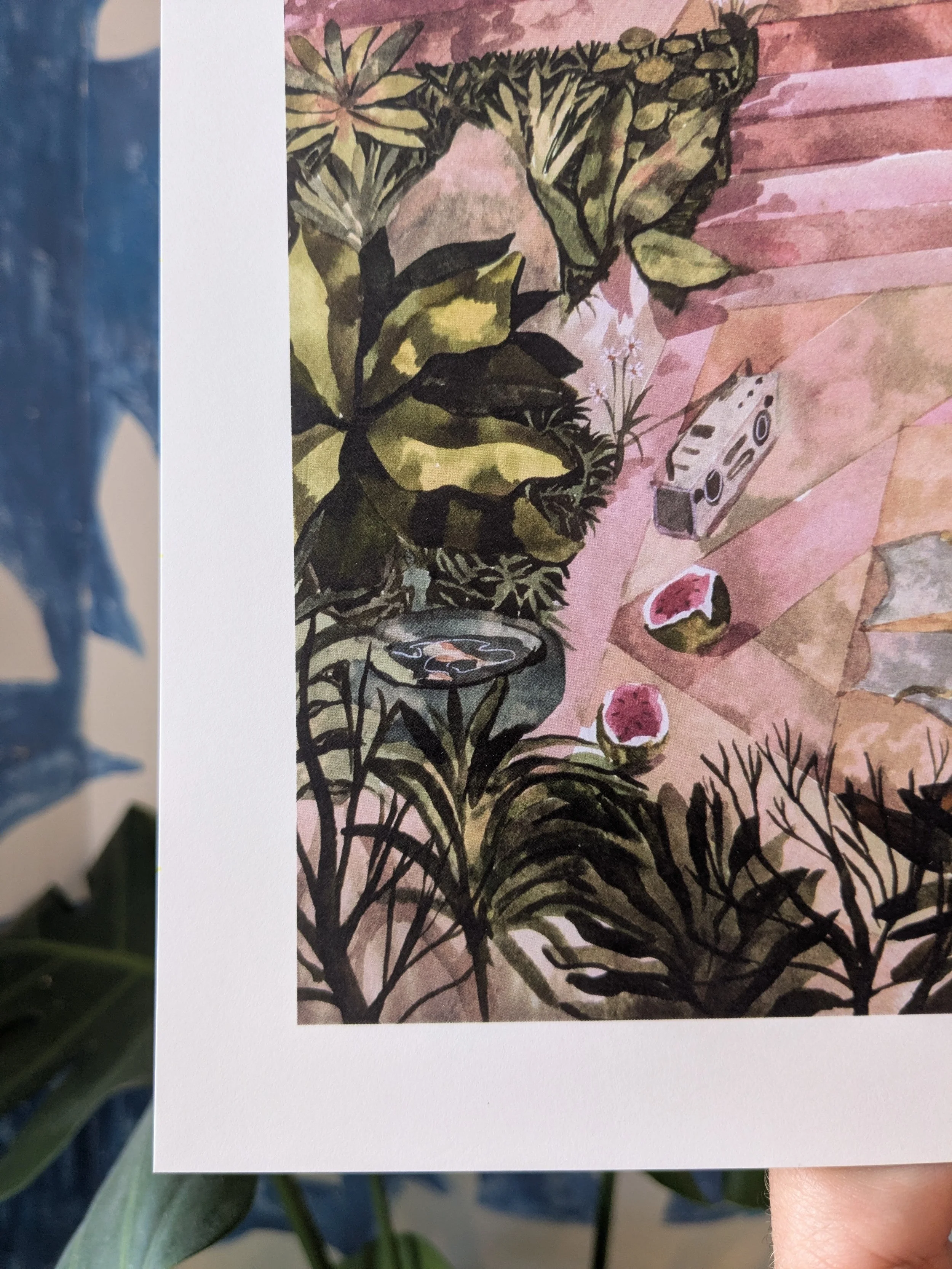
jungle that breaks our landmarks. The ink, diluted, blurred, allows marbled effects, transparencies or
gradations. And it is mainly in a palette of pinks and greens that the architectural and vegetal universe of
these imaginary places are diffused in the paper. From one image to another, we find a resonance,
between the varieties of plants and trees, the architectures, the colours, the objects, the characters that
seem to respond as if they belong to the same place, to the same idea.
About -
What is concretized in these drawings are feelings, desires, memories to which are associated colors,
landscapes, places, characters. These associations express a kind of softness of life, a quietness but
sometimes also a tension that would call a before or after. The use of a certain color palette pushes each
of these drawings to echo like the houses in the same neighborhood. There is often a warmth that
emerges, a summer atmosphere, a fire, night lights with an abundance of vegetation that gives the place
an intimacy or at least produces an isolation, a comfortable, even heavenly seclusion. But it is not just a
decor, it is spaces that open and close. A door, a window or even a hole lets us glimpse another room or
the shadows of a presence and calls us to imagine another space, a suite, at least a possible narrative
that everyone can follow or let fade away. Spaces are delimited more by opacity and abundance of
vegetation than they are actually enclosed. They invite us to follow the openings and to immerse
ourselves in the places.
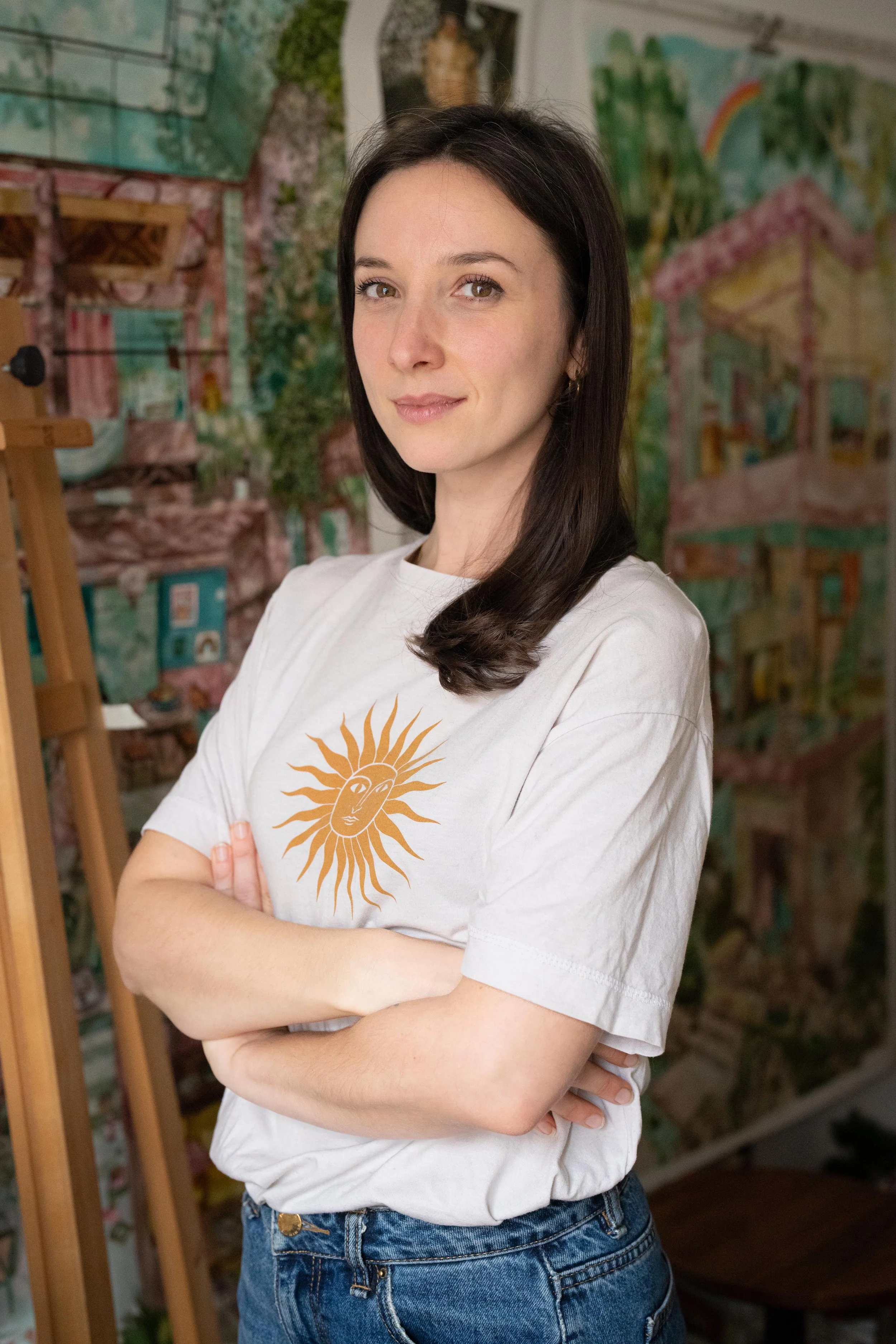
portrait by Studio Soleil
Bio -
Pauline Di Valentin, an artist from Amiens, produces ink drawings on paper depicting lost architecture in
the middle of abundant vegetation.
Pauline Di Valentin studied applied art from high school, and passed a BTS in visual communication at
the Lycée Auguste Renoir in Paris. She then joined the ESAD in Reims and obtained a DNAP in graphic
design. Today, she has found in ink painting the means to express the nuances of colours and textures
that inspire her.
In these drawings on paper, pastel villas stand in an isolated neighbourhood, in the middle of a dense
jungle that breaks our landmarks. The ink, diluted, blurred, allows marbled effects, transparencies or
gradations. And it is mainly in a palette of pinks and greens that the architectural and vegetal universe of
these imaginary places are diffused in the paper. From one image to another, we find a resonance,
between the varieties of plants and trees, the architectures, the colours, the objects, the characters that
seem to respond as if they belong to the same place, to the same idea.
About -
What is concretized in these drawings are feelings, desires, memories to which are associated colors,
landscapes, places, characters. These associations express a kind of softness of life, a quietness but
sometimes also a tension that would call a before or after. The use of a certain color palette pushes each
of these drawings to echo like the houses in the same neighborhood. There is often a warmth that
emerges, a summer atmosphere, a fire, night lights with an abundance of vegetation that gives the place
an intimacy or at least produces an isolation, a comfortable, even heavenly seclusion. But it is not just a
decor, it is spaces that open and close. A door, a window or even a hole lets us glimpse another room or
the shadows of a presence and calls us to imagine another space, a suite, at least a possible narrative
that everyone can follow or let fade away. Spaces are delimited more by opacity and abundance of
vegetation than they are actually enclosed. They invite us to follow the openings and to immerse
ourselves in the places.
portrait by Studio Soleil